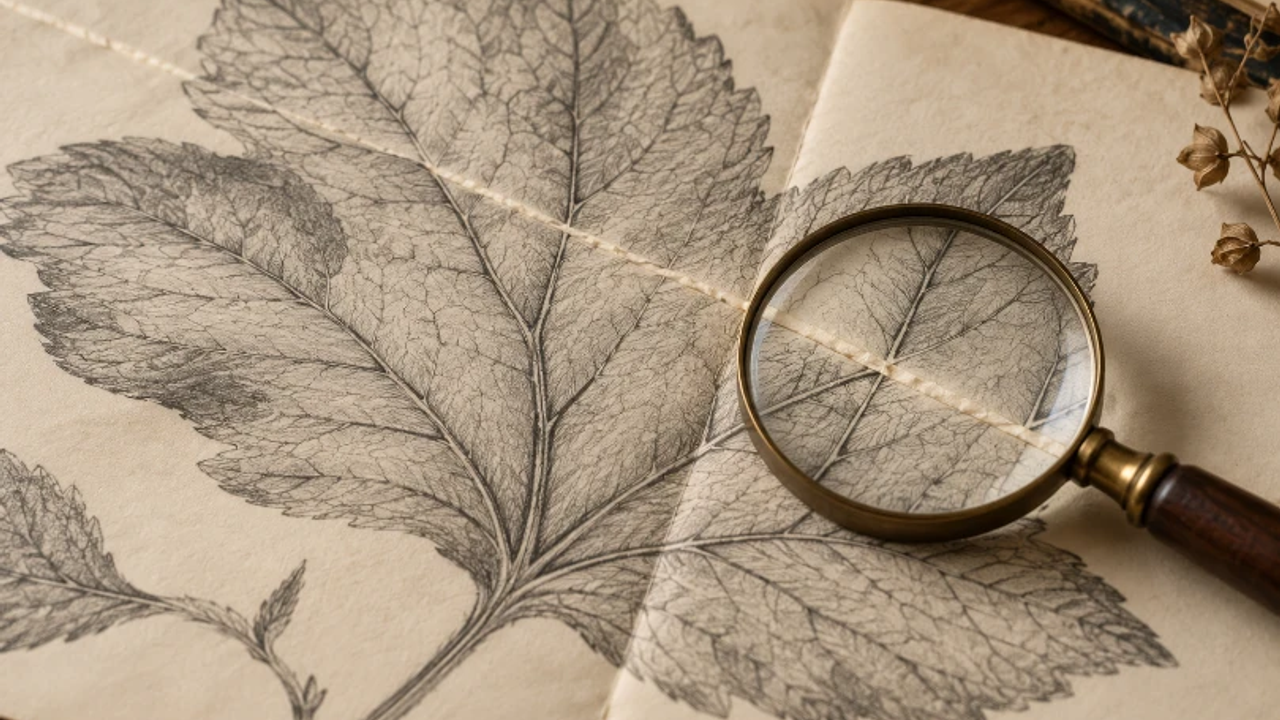
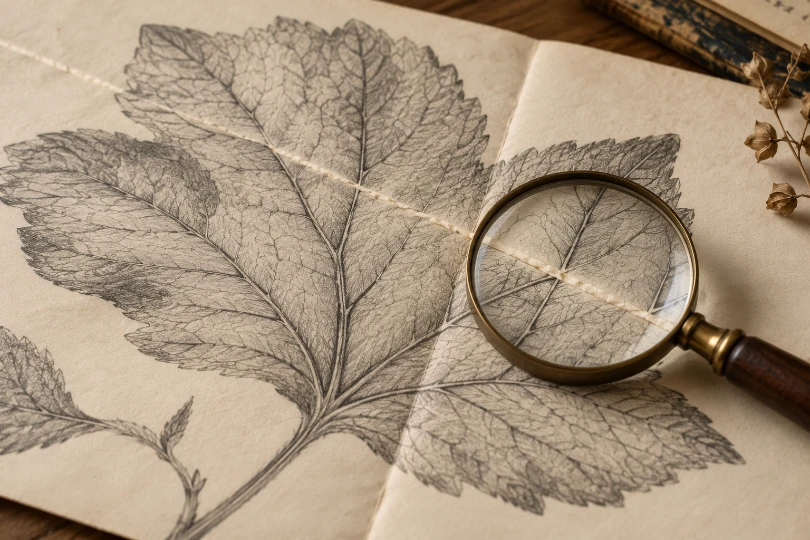
A crease crosses a scanned botanical drawing at the point where two pencil lines meet. Removing the crease could make the reproduction easier to view. It could also erase part of the drawing or invent a connection the artist never made. The difficult part is the intersection, where damage to the paper and marks on the paper occupy the same small area.
An AI Photo Editor can supply a cleanup candidate, but the original artwork remains the reference for what belongs there. Someone comparing photo editor AI options should separate a plausible repair from a faithful reproduction. A smooth-looking line is useful only when it agrees with the work, or when the result is clearly presented as an interpretation rather than an exact record.
Record the Drawn Marks Around the Fold
Start with the highest-quality scan or photograph reasonably available. For a hypothetical original leaf drawing, inspect where the crease crosses the stem, a vein, and a shaded area. These intersections have different risks. A stem may be interrupted, a vein may be mistaken for the fold, and shading may conceal whether the paper itself is lighter along the crease.
Before asking an AI Photo Editor to clean the scan, mark those uncertain areas in your own review notes. Do not rely only on a general impression that the paper looks damaged. The notes give you specific places to revisit after editing. They can also reveal that most of the crease is easy to assess while one short intersection remains uncertain.
PicEditor AI accepts an image and a written edit request, so the scan can be the starting material for a bounded experiment. Keep an untouched copy outside the editing session. If the physical artwork is available, use it to inspect ambiguous marks before deciding what a digital repair should do. Another photograph under suitable lighting may answer a question the scan cannot.
Distinguish the intended use of the reproduction. A decorative print inspired by the drawing allows different choices from an archival record of the original work. Both can be valid, but they should not carry the same claim of fidelity. Decide which one you are making before a convincing cleanup tempts you to treat an uncertain repair as confirmed detail.
Prepare a Bounded Request for the Paper Damage
Describe the crease by its location and ask for the surrounding drawing to remain. For example, the request might concern the pale diagonal fold crossing the lower part of the paper while preserving the visible pencil contours. This is a proposed brief, not a guarantee of selective repair. The returned image still needs comparison with the source.
PicEditor AI can generate an edited candidate from that instruction. Avoid combining crease cleanup with a new paper colour, stronger linework, and a different artistic style in the same first attempt. Each additional change makes it harder to tell whether an altered stem came from removing damage or from reinterpreting the drawing. Keep the initial task narrow enough to inspect.
A patch of empty paper may be easier to repair than a fold crossing fine marks. Treat that difference as useful information. The candidate can succeed along most of the crease and still fail at a crucial intersection. Do not let a large improvement in the blank margin outweigh a small but consequential alteration to the artwork.
Keep the intermediate result available without replacing the source. Several rounds of cleanup can gradually turn a delicate drawing into a more regular one. Comparing only adjacent attempts makes that drift easier to miss. Return to the untouched scan when judging the marks, even if the latest candidate looks cleaner than the one immediately before it.
Trace Each Crossing Through the Edited Drawing
Begin the review at the intersections recorded before editing. Follow a line toward the repaired area and out the other side. Does it continue in the same direction? Has a fine branch become thicker, vanished, or joined another mark? The eye often accepts a smooth connection quickly, so inspect the connection rather than treating smoothness as proof of accuracy.
A photo editor AI result may supply plausible detail where the original was ambiguous. For the leaf drawing, a newly tidy vein could be a sensible interpretation without being the artist's actual mark. Confirm it from the physical work or another reliable image where possible. If it cannot be confirmed, keep the uncertainty attached to the reproduction decision.
A crossing can fail in more than one way. The repaired line may stop short, join the wrong neighbour, or acquire an unsupported branch. Note the actual mismatch rather than labelling every change a loss of sharpness. That distinction gives the next edit request a specific job.
Check shaded areas separately from contours. A repair may preserve the outline while flattening the variation that gives the leaf its texture. Conversely, an attempt to retain every dark streak may leave the fold visible as if it were intentional shading. The right choice depends on what the source supports and on the reproduction's stated purpose.
Compare the result at both inspection size and final display size. Enlarging helps reveal altered marks, while the final size shows whether the remaining fold actually interferes with viewing. A slight paper trace may be acceptable in a faithful reproduction. An aggressive correction that changes the drawing may solve a problem that most viewers would never have noticed.
Inspect the unrequested areas too. A candidate that removes the crease while changing the outer leaf contour has not preserved the work. Pay particular attention to nearby fine lines with similar tone or direction to the damage. These can be easy to overlook because they were not the obvious target of the edit request.
Keep the Original Available Beside the Chosen Reproduction
PicEditor AI can help explore a paper-damage cleanup when the source is readable and the uncertain crossings can be reviewed. It is less useful as proof of what a concealed pencil mark originally looked like. Keep the untouched source and distinguish a confirmed reproduction from a creative interpretation.
Approve the version that improves viewing without silently changing the drawing's meaningful marks. Where an intersection remains uncertain, compare it with the original once more before choosing its treatment. The next person reviewing the work should still have access to the source that informed the choice.